Discovery Package
of Acu-AnMo acupuncture:
Joint Pain & the Barriers
🟡 Barriers (dams on the energy flow) are the most common cause of joint pain.
🟡 Their treatment with Acu-AnMo is surprisingly effective.
🟡 Immediate effect, whether the pain was recent or long-standing.
🟡 Marked improvement, if not a cure, during the session through repetition of the single point.
🟡 Pain in the Lower Back, Shoulder, Elbow, Wrist, Knee, Hip, Ankle
Discovery Package :
the Barriers
The first 4 videos of the Acu-AnMo online course
for only € 975
(or 2 monthly installments of € 495)

✴️ 1. Theoretical basis of Acu-AnMo
✴️ 2. Barriers: basic concepts.
Upper limb Barriers: pain in the shoulder, elbow, wrist
✴️ 3. Lower limb Barriers: pain in the hip, knee, and ankle. Lower back pain.
✴️ 4. Head and Neck Barriers: pain in the Neck, the TMJ, sinusitis, etc.
With these 4 videos,
applicable to patients from the second video onwards,
you will learn to:
✅ Diagnose a Barrier
✅ Choose the single point specific to each Barrier
(points never taught elsewhere)
✅ Locate it, and how to stimulate it with a stylus
None of this is taught anywhere else.
(A PDF document accompanies each video.)
After receiving the 4th video, you can either stop there,
or continue by registering for the rest of the course by paying the remaining balance.
If you have any questions, do not hesitate to ask them by the CONTACT page.
What are Barriers?

Guan, which we will translate as Barrier, means: “the way is shut”.
The modern simplified character 关 doesn’t tell us much, but the classical writing
shows that the doorway 門 is obstructed by “silk threads woven by invisible hands”.
(The silk threads indicate that the obstruction is energetic in nature.)
Now why do we use the words ‘dam’ or ‘barrier’ as a translation?
Because these references are much simpler to handle in order to make an easy diagnosis.
Barrier implies a kind of restriction on the way, and a dam nearly stops the flow of a river.
Sluice would also be a good word, because it stops the flow, but can be opened.
Anyway, the kind of energy disruption called Guan (even if nowadays the meaning of this word in Acupuncture is no longer understood, even in China), is the one where the energy flow is the most obstructed of all.
As a result, we will have too much energy upstream, and not very much downstream, like the water at both sides of a dam built on a river.

Now let us take an example. What happens when the centrifugal flow of Yang Qi is stopped by a dam (Guan) on the elbow?
There will be an increase of Yang Qi upstream, at the arm, the side from which the flow comes; and a decrease downstream, at the other side of the dam, at the forearm.
As a result, the arm side of the elbow will be a little warmer than the forearm side, which will be slightly colder.
Both sides may be warm, but the arm side will be warmer. Or both sides may be rather cold, but the forearm is the coldest side.
Don’t forget that the Yin/Yang system never gives an absolute information, it is only relative.
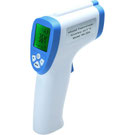
However, this difference is real, it can be measured with a forehead thermometer.
This gives you a glimpse of how we begin the reasoning to make a diagnosis of a Barrier.
Of course we will have to ascertain whether it is the Yin energy flow, or the Yang energy flow, that is blocked, and in which direction (centrifugal or centripetal).
Once this is done, which is quite simple, we will stimulate with a stylus in a precise way the single point that specifically opens the closed sluice :
for each big joint (because Barriers occur only there, plus some subtler locations in the neck and the lower back), for each type of blocked flow (Yin or Yang) and for each direction (centrifugal
or centripetal) there is a specific acupuncture point (thus 4 possibilities for each joint), which, when stimulated, immediately improves the patient's pain - and possible movement
restrictions - and the repetition of the stimulation of the same point will cure the pain (or at least largely decrease it, in which case the treatment will be completed during the next
sessions).