
What is Acu-AnMo acupuncture?
Acu-AnMo is an Acupuncture approach based on a fundamental, but usually neglected in practice, aspect of Traditional Chinese Medicine (TCM): all pain is due to an obstruction in the flow of energy in the body, and this disturbance can be of a different nature for apparently similar symptoms.
The goal is to make the diagnosis of the specific energy disturbance,
different from one patient to another, for seemingly similar symptoms,
and then to choose the one single acupuncture point to stimulate
whose action corresponds to the energy diagnosis,
in order to treat joint pain and neuralgia, with an immediate effect.
In other words, each point is chosen according to the individual diagnosis of what energy disruption causes the pain, and the effect of its stimulation with a stylus must be instantaneous (otherwise the energy diagnosis or the chosen point was not the right one...).
Because we treat only one point at a time, and we test its effect immediately, and then we repeat it as long as it improves the patient, util healing.
This original approach is made possible by the fact of not using needles, but a metal stylus that does not pierce the skin but stimulates the point thanks to a specific manipulation.
The effectiveness of acupuncture is thereby greatly increased.
And patients not only appreciate the immediate effects, but also the fact that it is totally painless.
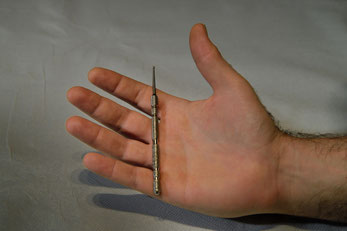
Our single point approach is therefore radically different from usual Acupuncture, based (even in China) on treatment one-size-fits-all recipes, involving many points pricked at the same time, without knowing what action each point has on energy.
So instead of using many needles often left in place for 1/2 hour, we stimulate one point, chosen in a logical and reasoned way, with a stylus manipulated in a specific way for about a minute: the immediate improvement of the patient confirms the good choice of the point.
Which can then be stimulated again if necessary - which could not be done with needles.
In addition, in some specific case of energy insufficiency, we use moxas.
Note that among the 9 types of classical needles mentioned 2000 years ago in the Nei Jing Ling Shu, 2 have round ends - therefore not made for pricking...
Using a stylus also has the advantage of being non-invasive, and therefore applicable to everyone.
Particularly interesting and quick effects
The effects of Acu-AnMo are particularly interesting and rapid, notably for (just as examples):
- lower back pain
- shoulder pain, and other joint pain, recent or ancient
- joint pain with or without osteoarthritis (shoulder, knee, hip, neck, etc.),
- neuralgia and sciatica,
- multiple pains
- pain aggravated by rest or at night, or at the start of a movement or on rising, as for example (but not exclusively) in Rheumatoid Arthritis or Ankylosing Spondylitis;
- non-articular pathologies, such as headaches and migraine, or anxiety, etc.

Point chosen by individualized reasoning
Each Acupuncture point has a very precise energetic action, which is specific to it (an action usually ignored), which we will describe in our training for the points that we use (actions that are not found in any books; by the way the same applies to the energetic reasoning that we will explain).
We therefore use Acupuncture points in a reasoned way: according to the effect of the acupuncture point not only on the location of the pain, but also according to the specific energy disruption causing the pain : Barrier, Yin Stagnation, Excess of Yang, Blood Stasis, etc.
This has infinitely quicker and lasting effects than the usual point combinations found in books (which are usually rather disappointing), as is still done too often: for such a symptom, such points (generally numerous...).
In Acu-AnMo, it is on the contrary: for such energy disruption, such single point.
Why the term “Acu-AnMo”?
The term "acupuncture" was created in the 17th century by a Dutch merchant, Wilhelm Ten Rhijne, who had learned some of it in Japan.
Acu means needle in latin, and puncture means to pierce the skin.
However the Chinese term, Zhen Jiu 針刺, does not necessary imply piercing, since it's translation is simply "needle and moxa".
In Acu-AnMo we do not puncture, but we use the round-tipped needle mentioned in the ancient classic text 'HuangDi NeiJing LingShu' to stimulate the (single) chosen acupuncture point.
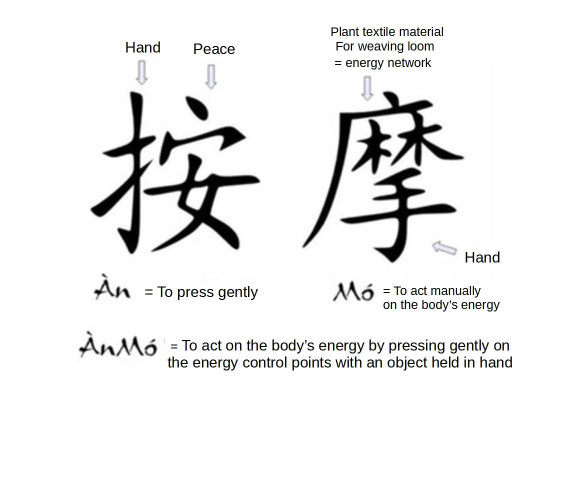
AnMo, as shown by the breakdown of the corresponding ideograms, means "to act gently on a point regulating the energy of the body, with an object held in the hand".
We never prick the chosen point.
In some precise cases we also use Moxas.
